


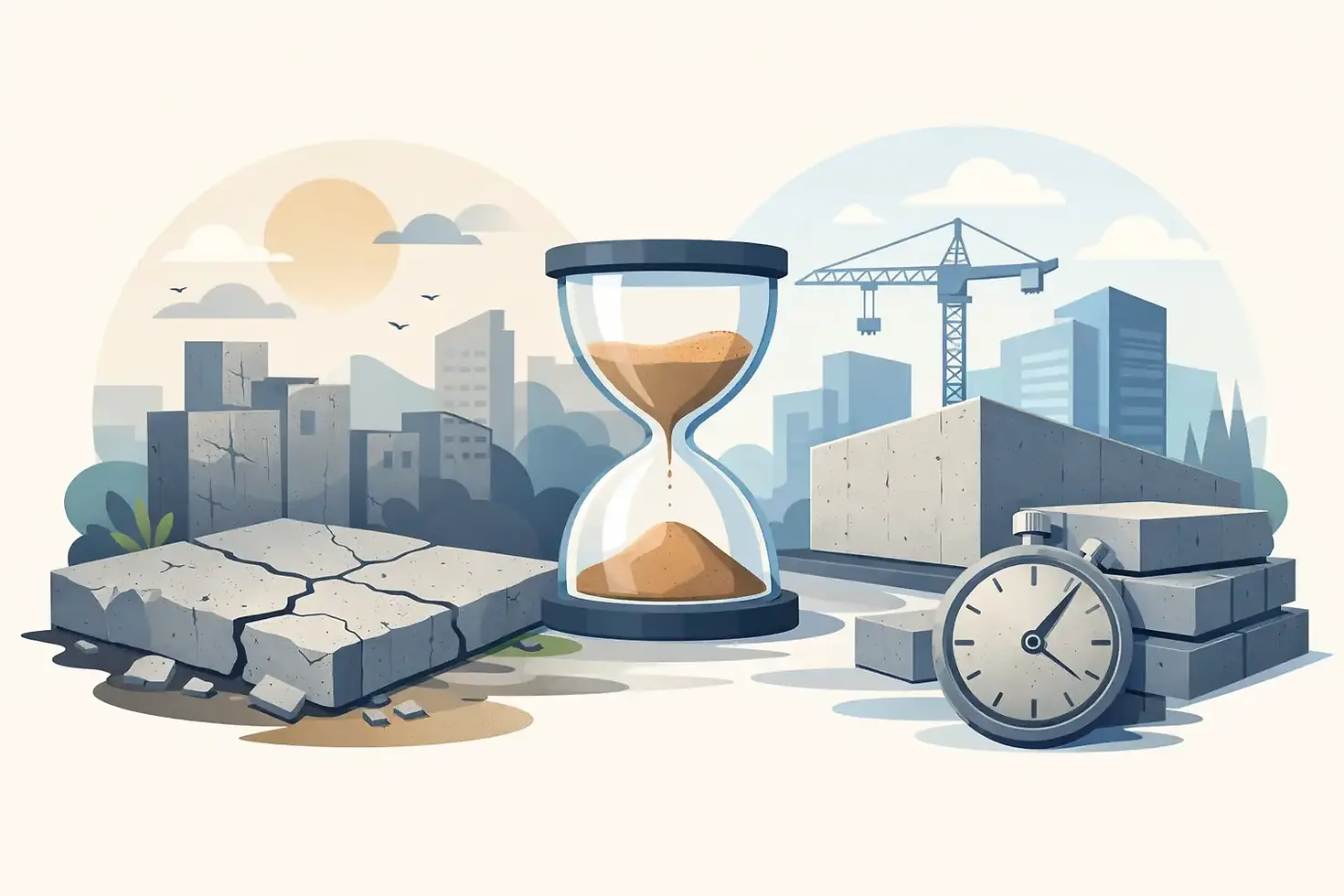
How Long Does Concrete Last?
- uptopcontracts
- Mar 18
- 6 min read
A concrete driveway can look solid for years, then one winter later it suddenly has scaling, cracks, or sinking sections. That is why homeowners and property managers keep asking the same question: how long does concrete last? The honest answer is that concrete can last for decades, but the lifespan depends heavily on where it is installed, how well the base was prepared, how water moves around it, and how it handles freeze-thaw weather.
For exterior concrete in Southern Ontario, a realistic expectation is often 25 to 40 years for well-installed slabs, with some lasting longer and some failing much earlier. The gap between those outcomes usually comes down to workmanship, site conditions, and maintenance - not sales promises.
How long does concrete last in real conditions?
Concrete is not a one-number material. A backyard pad, a front walkway, a municipal-style curb, and a driveway all deal with different loads and drainage conditions. A residential walkway with proper slope and limited weight can stay serviceable for a very long time. A driveway carrying vehicles every day, exposed to road salt and snow clearing, will generally wear faster.
In practical terms, plain exterior concrete often performs well for 25 to 40 years when it is installed correctly. Basement entrances, steps, and walkways may last toward the higher end if water is managed properly and they are not constantly exposed to heavy impact or salt buildup. Driveways and commercial traffic areas tend to have more stress, so the lower to middle part of that range is more common.
That said, age alone does not tell the full story. A 12-year-old slab that was poured on a weak base can be in worse shape than a 30-year-old slab that was built properly from the start.
What actually determines concrete lifespan?
The biggest factor is not the concrete truck. It is the preparation underneath.
Base preparation matters more than most people realize
Concrete is only as reliable as the base supporting it. If the subgrade is soft, poorly compacted, or holding water, the slab is far more likely to crack, settle, or heave. Many early failures are not really concrete failures at all - they are support failures.
For driveways, walkways, and pads, the base needs to be properly excavated, built up with the right granular material, and compacted to reduce movement. If that work is rushed, the slab may look good at first but start shifting after a few freeze-thaw cycles.
Water is one of concrete's biggest enemies
Concrete can handle weather, but standing water changes the equation. Poor drainage around the slab, downspouts dumping beside it, negative grading, or trapped moisture below the surface can shorten its life quickly. In Southern Ontario, water that freezes and expands creates repeated stress on the slab and the base below.
This is why slope matters. A slab should shed water away from the house and away from areas where it can pool. Proper drainage is not an extra feature. It is part of what makes concrete last.
Climate and salt exposure add wear
Freeze-thaw cycles are hard on exterior surfaces. De-icing salts can make the problem worse, especially on newer concrete or concrete that was not finished and cured properly. Surface scaling is one of the most common complaints after winter, and while some light flaking is cosmetic, widespread scaling can point to deeper durability issues.
Steps, entry areas, and front walkways often see more salt use than other sections of a property. Commercial entrances can be especially vulnerable because safety concerns lead to heavier de-icer application.
Thickness and intended use matter
Concrete needs to match the job. A slab designed for foot traffic is not the same as one designed for daily vehicle loads. If the thickness is inadequate for how the surface will actually be used, cracking and settlement become more likely.
This is one reason honest estimating matters. A contractor should ask how the area will be used instead of assuming every slab can be built the same way.
Finishing and curing also affect long-term performance
Concrete does not reach its potential strength the day it is poured. The finishing process and the curing period both affect durability. If the surface is overworked, too much water is introduced, or curing is neglected, the top layer can become weaker and more prone to scaling and wear.
A slab can look clean on day one and still have reduced long-term performance if those steps were handled poorly.
Signs your concrete is aging normally vs failing early
Not every crack means replacement is needed. Concrete naturally develops some hairline cracking over time, and minor cosmetic wear is common in outdoor installations. The key is knowing the difference between normal aging and structural decline.
Hairline surface cracks, slight discoloration, or minor edge wear may be manageable for years. These issues do not always affect safety or function.
The bigger concerns are settlement, trip hazards, large movement at joints, widespread surface delamination, deep scaling, and cracks that continue opening because the slab is shifting. If one section of a walkway is sinking or a driveway slab is rocking under load, the problem is usually below the surface. In those cases, patching the top rarely fixes the real issue.
For commercial properties, early warning signs matter even more because liability is part of the equation. Uneven sidewalks, broken curbs, and unstable entry areas can create safety risks long before the concrete is fully worn out.
Can concrete last longer with maintenance?
Yes, but maintenance has limits.
Keeping water away from the slab helps. That includes managing downspouts, correcting drainage issues, and avoiding situations where snowmelt sits on the surface for long periods. Cleaning the surface and resealing when appropriate can also help protect against moisture and surface wear, depending on the finish and application.
Winter care makes a difference too. Using de-icers carefully, especially during the first season after installation, can reduce unnecessary damage. Metal shovels and aggressive scraping can also rough up edges and surfaces over time.
Still, maintenance will not turn a poorly built slab into a long-lasting one. It can extend the life of good concrete, but it cannot compensate for inadequate excavation, weak compaction, or bad drainage design.
Repair or replace?
This is where many property owners waste money by trying to save a slab that is already past the point of worthwhile repair.
If the concrete is mostly sound and the issue is limited to small cracks, localized surface damage, or minor joint deterioration, repair may make sense. The goal is to preserve safe use and slow further deterioration.
If the slab is sinking, separating, badly scaled, or broken across multiple areas, replacement is usually the better long-term decision. Spot repairs on failing concrete often become short-term cosmetic fixes. They may look better for a while, but they do not restore the original integrity of the slab or the base below it.
A trustworthy contractor should explain that difference clearly. There is no value in selling a cheap repair if the surface will continue moving and create the same problem again.
How long does concrete last when it is installed right?
When the site is prepared correctly, the slab thickness suits the application, drainage is handled properly, and the finishing is done with care, exterior concrete can give property owners decades of service. That is true for residential driveways and walkways, and it is equally true for commercial sidewalks, curbs, ramps, and entry areas.
The reason some concrete lasts 30 years and some lasts 10 is usually not luck. It is planning, workmanship, and realistic expectations from the start.
For property owners comparing quotes, this is worth keeping in mind: the lowest price often leaves out the parts you cannot see after the pour. But those hidden steps are exactly what determine whether the concrete performs through Ontario winters or starts failing long before it should.
If you are looking at old concrete and wondering whether it has a few good years left or it is time to start over, the smartest next step is not guessing from the surface alone. It is having the base, drainage, slope, and damage pattern looked at honestly. Good concrete should last a long time, but lasting a long time starts well before the truck arrives.


Comments